Research:
Growth mindset in the workplace
New research by TalentLMS explores the critical role of a growth mindset at work. The report reveals the missing growth skills, how AI impacts continuous learning, and key obstacles in developing a growth mindset culture.

Mindset drives profits: 80% of executives agree that employees’ growth mindset directly contributes to revenue growth.
Key takeaways
AI hinders learning
53% of executives think that generative AI will hinder the development of a growth mindset in the workplace.
Key to future wins
89% of senior leaders agree that future business success will depend on leaders who embody a growth mindset.
Fueling org success
88% of executives say a growth mindset is important for organizational success, emphasizing its critical role.
- Introduction
- Framework for defining a growth mindset
- Why is a growth mindset important?
- 10 tactics for nurturing growth mindset
- Two sides of a growth mindset
- What helps executives develop growth mindset skills
- How can organizations nurture a growth mindset culture?
- The barriers to developing a growth mindset
- Unlocking a growth mindset with learning and development
- Leadership through the lens of a growth mindset
- Combining AI with a growth mindset in learning
- The missing pieces: A plan for the future
- Conclusion
- About this research
Introduction
At a recent company gathering where TalentLMS employees from across the globe came together, our CEO gifted everyone a copy of Carol Dweck’s book, “Mindset.” A book that got us thinking.
How prevalent is a growth mindset in the workplace in general? Is it actively encouraged? And what are the motivators and barriers associated with developing a growth mindset?
Inspired to find answers, we decided to explore the concept of a growth mindset in a broader context. We also wanted to link our insights to practical takeaways and offer organizations tangible ways to improve growth mindset initiatives. With all of this in mind, our next TalentLMS research project was born.
In an era where the workplace is constantly evolving—one of continuous change and innovation—fostering a growth mindset is more critical than ever. Understanding how this mindset impacts employee development, leadership effectiveness, and overall company culture can offer a competitive edge in navigating these challenges.
To evaluate how a growth mindset is perceived and embodied at varying levels within organizations, we surveyed two groups. These comprised 300 senior leaders/executives and 1,000 non-executive employees in U.S. companies across industries. We probed deeper into each segment to evaluate individual and group perceptions. And to learn more about the strategies used to develop and nurture an effective growth mindset. Some questions were common to both groups.
Others were unique to each.
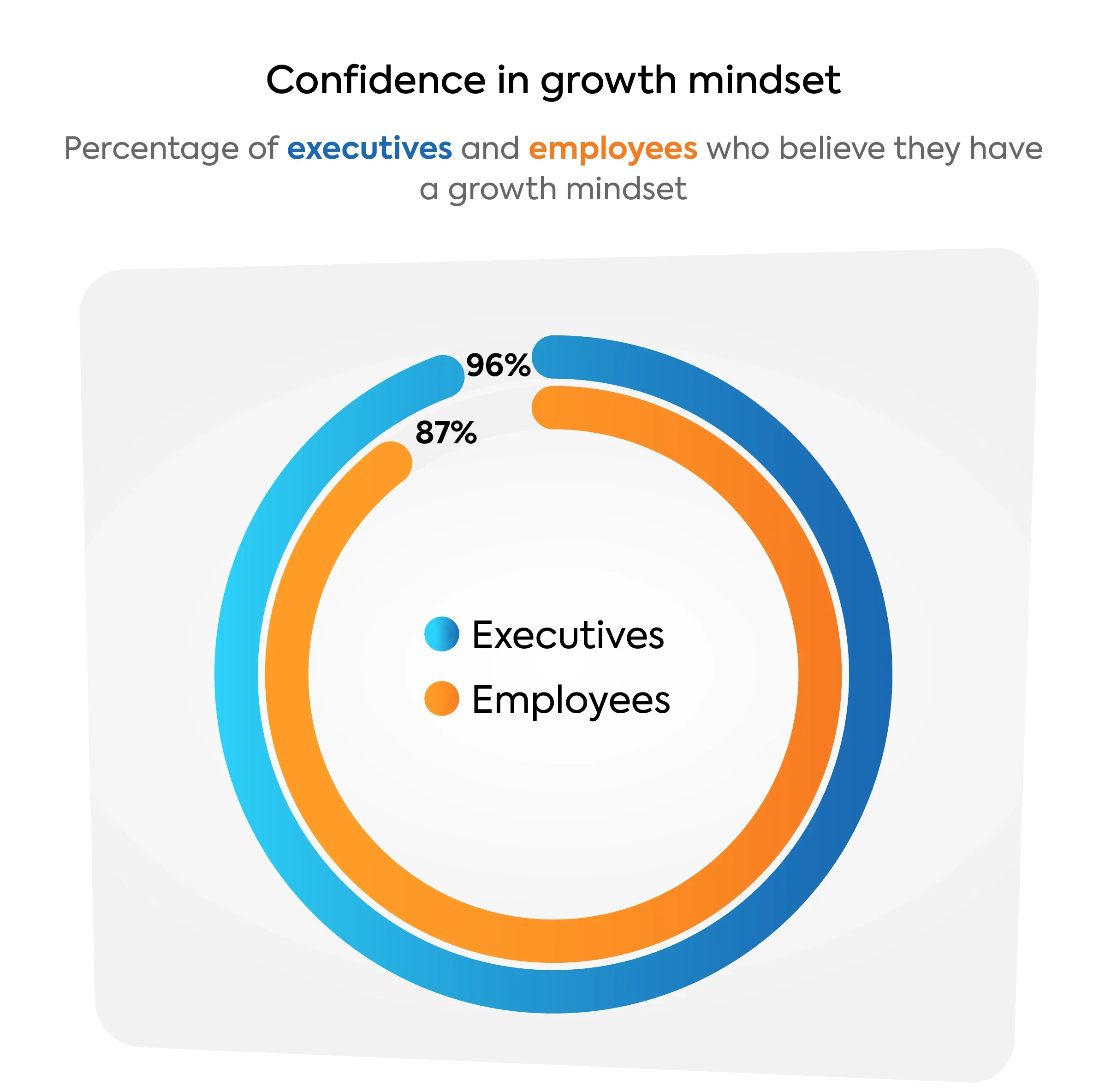
Several data patterns emerged when we approached the scope and scale of our research this way. Along with a plethora of valuable insights. For example, regardless of responsibility or role, most of the workforce (especially leaders) believe they have a growth mindset.
But does this translate into demonstrable behaviors, actions, and outcomes? When we asked respondents to rate their counterparts on this, the color starts to fade.
Time to explore the bigger picture.
Framework for defining a growth mindset
Before diving into the findings, let’s set out the framework for our research. What do we mean by a growth mindset, and why does it matter?
Attitude, not aptitude
A growth mindset is a belief that people can develop their intelligence, abilities, and talents over time through effort and practice. At the other end of the scale is the idea that individuals can’t significantly alter those attributes. This is known as a fixed mindset.
In two minds: Adjusting the balance
When interpreting the results of our research, it’s important to note that the two mindset types (fixed and growth) aren’t mutually exclusive. To a greater or lesser extent, everyone has a combination of both. The balance shifts according to experience and circumstance. For example, a difficult colleague or conflicting priorities outside work might result in a shift from a growth to a fixed mindset. It’s also a myth that people are either born with a growth mindset or not. Individuals can nurture all associated skills and traits through practice, learning, and reflection. Which is why organizational input is so important. Training strategies and company culture can either make or break a growth mindset.
The concept of a growth mindset (and its counterpart) emerged when Stanford professor and psychologist Carol Dweck observed students’ reactions to challenges in the classroom. What Dweck witnessed highlighted attitude, not aptitude, as the key determinant of success. Some children thrived when faced with failure. For others, it stopped them in their tracks.
A powerful principle, its application quickly moved beyond the classroom and into the workplace. It provided a framework for all employees, from entry-level roles to C-suite management positions. Fast-forward, and now 62% of training professionals believe that a growth mindset is the critical driver of innovation in L&D.
The building blocks of a growth mindset
People with a growth mindset call on specific strategies, characteristics, skills, and capabilities to improve performance and overcome setbacks. Using these, they break complex challenges down into achievable steps. The following lists include the growth mindset building blocks we’ve pinpointed and examined in our research.
Traits of a growth mindset
- Continuous learning: Constantly expanding knowledge and abilities
- Resilience: Persisting through difficulties
- Positive outlook: Using failure and mistakes as opportunities to learn and grow
- Courage: Embracing challenges instead of avoiding risks
- Open-mindedness: Welcoming feedback and valuing criticism
- Persistence: Working hard and maintaining effort over time
- Adaptability: Responding well to change
Traits associated with a growth mindset are vital in ongoing professional development. But you can’t inherently train on traits. What you can do is develop the skills associated with these traits. And those are the ones we’ve outlined below.
Skills associated with a growth mindset
Ability to learn | Active listening | Adaptability | Creative thinking | Critical thinking | Emotional intelligence | Flexibility | Goal-setting | Persistence | Problem-solving | Receptiveness to feedback | Reflective thinking | Resilience | Risk-assessment | Self-discipline | Self-reflection | Stress management | Time management
Why is a growth mindset important?
A growth mindset is typically a force for good for employees and organizations. Moving forward, we’ll dive deeper into this as we break down the results of this research later. But let’s set the scene with some general observations and high-level data.
More opportunities for businesses and employees
Generally speaking, organizations that prioritize a growth mindset value passion and potential over pedigree. Everyone is considered and judged in their own right. Not just those with formal qualifications or a long list of past accomplishments. This widens and enriches candidate pools. It gives HR teams and hiring managers more scope to choose best-fit prospects, internally and externally. It also opens up opportunities for more individuals looking to progress in their careers.
With all of these factors in place, collaboration and innovation play out more effectively, too. Nearly half of all employees in a “growth mindset” company say this commitment fosters innovation. Plus, 65% say it supports risk-taking, and 47% say it makes colleagues more trustworthy.
An engaged and stable workforce
Internal hiring is more common in organizations that favor a growth mindset approach. Instead of looking elsewhere for new skills, existing talent is nurtured and developed. Because of this, employees feel engaged, invested in, and equipped with the right skills to perform well in their roles—and beyond. This then leads to lower levels of employee turnover.
Fueling the bottom line
We know that 86% of HR managers say training (the bedrock of a growth mindset) is beneficial for the retention of employees. And 66% of employees associate learning with company loyalty. The result? Companies save money on recruitment. Skill sets remain current and competitive. And productivity and profit levels stay high and healthy. How do we know? Time for a teaser from our latest research. Eighty percent of executives we polled agree that employees’ growth mindset directly contributes to revenue growth. And 88% of executives agree that a growth mindset is essential for organizational success.
10 tactics to improve growth mindset initiatives in your organization
Our research identified 10 key obstacles currently blocking the success of a growth mindset culture in the workplace. Here, we turn those insights into 10 actionable strategies.
#1 Address the belief vs. behavior growth mindset disconnect
THE CHALLENGE
“Most executives believe they have a growth mindset, but employees say they don’t lead by example.”
THE SOLUTION
- Leaders should set personal growth goals and share them publicly. And hold regular check-ins with teams to discuss the progress of their personal learning journey.
- Use internal communications channels to communicate growth mindset intentions. Provide specific details on how leaders and the organization are supporting these.
- Hold open forums and Q&A sessions where employees can ask questions or discuss concerns about leadership behaviors.
#2 Banish misconceptions around growth mindset and reward and recognition
THE CHALLENGE
“43% of employees think a growth mindset is an excuse to assign employees more responsibility without adequate compensation.”
THE SOLUTION
- Hold workshops and training sessions to debunk the myths around the growth mindset.
- Be clear and transparent about pathways for development, promotions, and advancement.
- Link growth opportunities and achievements to tangible benefits, rewards, and incentives.
- Review compensation structures and recognition programs to ensure they’re fair and appropriate.
#3 Deliver a company-wide change campaign
THE CHALLENGE
“Resistance to change is the most significant obstacle organizations and individuals face when developing a growth mindset culture.”
THE SOLUTION
- Start a company-wide conversation around change.
- Share strategies for dealing with fear or uncertainty around change.
- Create a compelling, high-level change story and use C-suite leaders to communicate this. (Pro tip: Business transformations are 5.8 times more likely to be successful when delivered bya CEO.)
#4 Provide time and a safe space for taking risks
THE CHALLENGE
“Fear of failure is the biggest obstacle to the personal development of a growth mindset for employees and executives.”
THE SOLUTION
- Regularly and publicly repeat the message that taking risks is acceptable and encouraged.
- Discuss mistakes as learning opportunities at senior leader level.
- Encourage executives to share personal experiences around risk-taking and specific examples of their own response to challenges.
- Use AI-generated simulations and scenarios to enable employees to practice risk-taking in a safe environment.
#5 Take a clear and consistent stance on the abuse of power
THE CHALLENGE
“A fifth of senior leaders have witnessed leadership gatekeeping within their organization.”
(*Leadership gatekeeping is the practice of blocking the progression and development of others to maintain power.)
THE SOLUTION
- Assess leaders on inclusivity, collaboration, and knowledge-sharing behaviors in performance reviews.
- Assign rewards or repercussions based on the extent to which these behaviors are met or missed.
- Apply a consistent and transparent approach to any attempts to sabotage growth and development.
- Create a safe space for employees to speak openly and report any abuse of power.
#6 Help leaders offset delivery with development
THE CHALLENGE
“42% of executives struggle to balance short-term business goals with long-term growth mindset initiatives.”
THE SOLUTION
- Pair executives with experienced mentors who can offer valuable insights on balancing workload with learning and development.
- Schedule regular reviews where executives can review workload, identify misalignments, and discuss strategies as needed.
- Encourage executives to delegate short-term tasks to capable team members. As well as freeing up time, this helps develop leadership skills across the organization.
- Implement shared leadership models where responsibility for short-term goals is distributed among multiple leaders.
#7 Reevaluate learning methods
THE CHALLENGE
“Employees’ preferred learning methods are out of sync with current L&D initiatives.”
THE SOLUTION
- Measure the impact of existing training methods (including course completion rates, course sign-ups, engagement rates, and assessment scores).
- Conduct a needs assessment. Gather new data through surveys, interviews, and focus groups to understand your employees’ preferred learning methods.
- Compare current L&D initiatives with employee preferences to identify specific gaps or areas of misalignment.
- Consider how different learning styles and preferences suit different training topics associated with developing a growth mindset.
#8 Bolster tight training budgets with cost-effective solutions
THE CHALLENGE
“56% of executives agree it’s challenging to find the budget for employee development.”
THE SOLUTION
- Leverage free or affordable eLearning resources. For example, online training videos, webinars, and learning management platforms with in-built course libraries.
- Facilitate on-the-job training. Upskill employees and allow them to learn from real work and experienced colleagues without additional training costs.
- Tap into in-house expertise. Encourage knowledge-sharing and peer training programs led by internal SMEs.
- Utilize microlearning possibilities. These short modules can be developed in-house or sourced externally relatively cheaply.
#9 Invest more in AI training and tools
THE CHALLENGE
“59% of employees think AI-powered training tools can help them develop new skills, but less than a third have access to AI-powered training tools.”
THE SOLUTION
- Pilot AI-powered tools in high-impact areas or areas where upskilling is a priority. Gather ROI data to produce a business case for future investment.
- Conduct a cost-benefit analysis around using AI-powered tools for training. Reallocate resources if this highlights significant advantages over traditional training methods.
- Look for AI-powered training tools that are (or can be) integrated into existing platforms without additional investment.
#10 Use detailed reporting to keep senior leaders invested in a growth mindset culture
THE CHALLENGE
“Less than half of executives link increased profitability and growth rates with a growth mindset.”
THE SOLUTION
- Use metrics that evaluate short and long-term impact.
- Include the following metrics in your reporting dashboard:
- Promotion and internal mobility
- Employee engagement levels, including Employee Net Promoter Score (eNPS)
- Skills acquisition, course participation, and course completion rates (these can be automated through a learning management system)
- Retention and attrition
- Personal development objectives
- Innovation metrics (ideas generated, products developed) and productivity trends
- Customer satisfaction and loyalty
- Revenue growth and market share
Belief vs. behavior: Two sides of a growth mindset in the workplace
A growth mindset proves its worth in how people think and act. For it to make a difference, individuals need to go beyond understanding the theory. They need to commit to and carry out continuous learning. And actively encourage others to do the same.
All in the mind? Most execs don’t lead by example, say employees
Our research shows almost all executives (96%) believe they have a growth mindset. And 90% believe that leading by example is key to creating a growth mindset culture. Yet, most employees (54%) don’t see much evidence of this. For 24% of employees, leaders in their company rarely or never demonstrate a growth mindset. And 31% say they do so only sometimes.
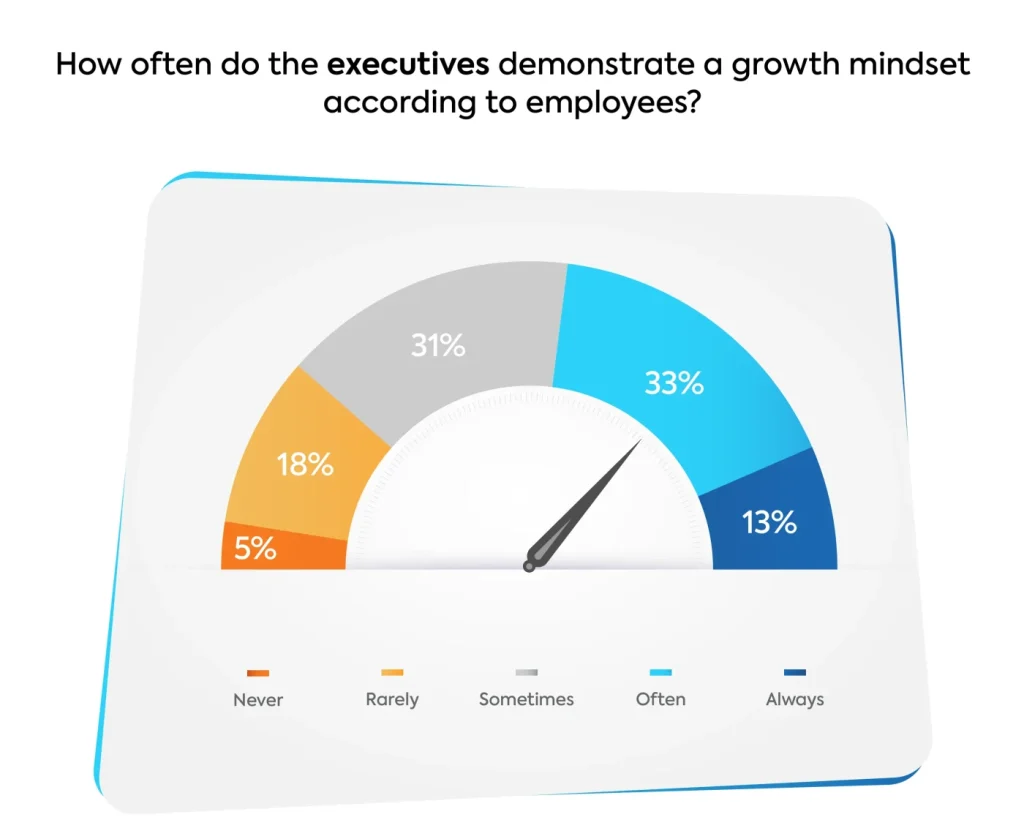
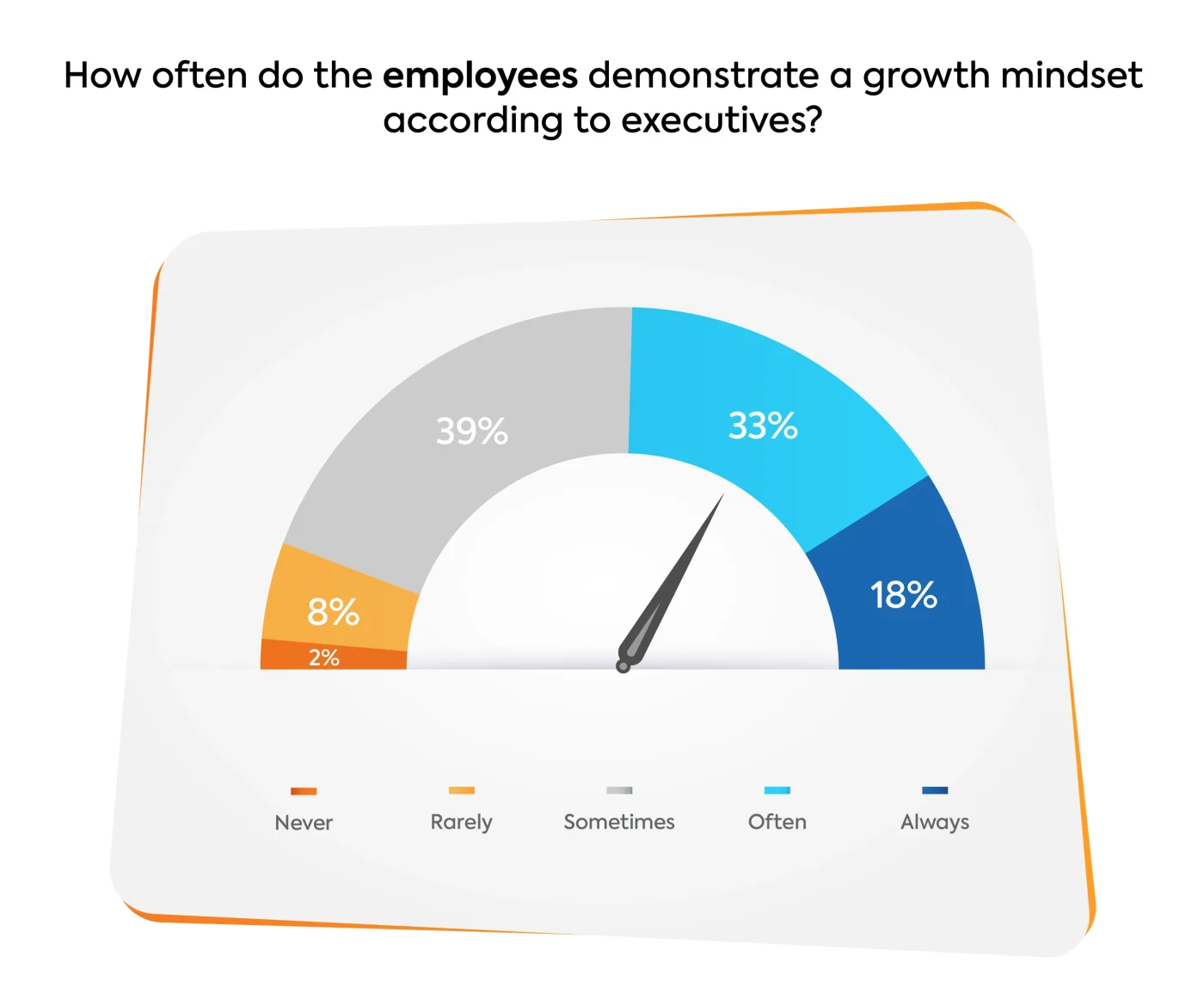
When it comes to employees, the gap isn’t quite so wide. But a similar pattern emerges. Eighty-seven percent of employees believe that they have a growth mindset. Over half of leaders (51%) confirm this, saying employees often or always demonstrate a growth mindset. But a hefty percentage (49%) of executives still say employees do so only sometimes, rarely, or never.
Top growth mindset behaviors go undetected
The disconnect highlighted by the ‘belief vs. behavior’ data above raises a red flag. It also raises interesting questions. Are growth mindset principles understood and internalized by leaders but not actively embodied? Or is visibility (not behavior) the issue? To provide a clear call to action for leaders and L&D teams, we need to learn more about the context.
Growth mindset behaviors are closely aligned with growth mindset development strategies. Both reinforce and support each other in creating a culture of continuous learning, resilience, and adaptability. As part of this research, we had executives rank how helpful they found various growth mindset development tactics. The results? Most executives may model a growth mindset in their behavior. But the strategies they use could well be falling off the radar.
Let’s break it down.
What helps executives develop growth mindset skills
To uncover the mechanics behind developing growth mindset skills, we asked executives to rate what helps them build those skills. This is how they responded.
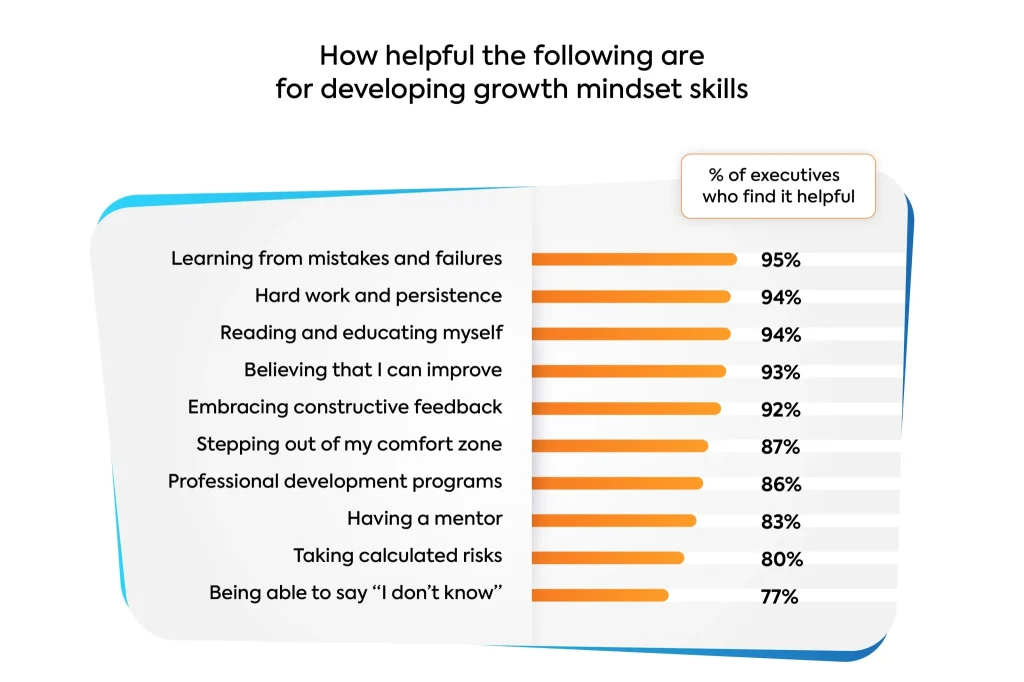
The data shows a preference for inward-facing, subtle tactics for developing growth mindset skills. Specifically, over 9 in 10 senior leaders rely on learning from failures, hard work, self-study, believing in their self-improvement and embracing feedback.
These inward-facing, autodidactic tactics may be very effective on an individual level. But they don’t make much noise, which could explain why most employees aren’t picking up on them. Should leaders stop using these tactics? Absolutely not. But it could mean that organizations (and executive teams) need to talk more openly about growth mindset principles. And be more transparent about promoting a growth mindset culture.
Other tactics helping the majority of executives include stepping out of their comfort zone and engaging in professional development programs. These approaches, though slightly less emphasized, are still highly valued by a significant portion of leaders. Having a mentor and taking calculated risks also play a critical role, though to a lesser extent.
Finally, being able to say “I don’t know” and taking risks are less emphasized, even though they’re recognized as valuable. As such, they are not as frequently practiced and may not be as openly acknowledged.
How can organizations nurture a growth mindset culture?
Culture defines itself through lived values. It requires a gentle, regular commitment. And the continued affirmation of attitudes through day-to-day interactions and practices. A growth mindset in the workplace doesn’t have to be formalized within businesses.
“The key to cultivating a growth mindset is to see the unknown and the new as opportunity versus threat. When we see new situations as threats, we become fixed and return to habits that have allowed us to succeed in the past even when they are insufficient to meet the moment we are in.”

Employees can follow the principle independently and still benefit from it. But an ongoing, collective commitment goes a lot further. It creates a coherent culture that can influence everything from hiring, collaboration, L&D, and management style to practices, processes, and productivity. These elements are all affected if organizations don’t actively promote or support a growth mindset culture. Individual attempts to live (and work) by the principles are also harder.
In this section, we explore what our research revealed about nurturing a growth mindset culture within organizations. We’ll look at commitment levels and discuss the benefits, barriers, strategies, and motivators.
Leading the way
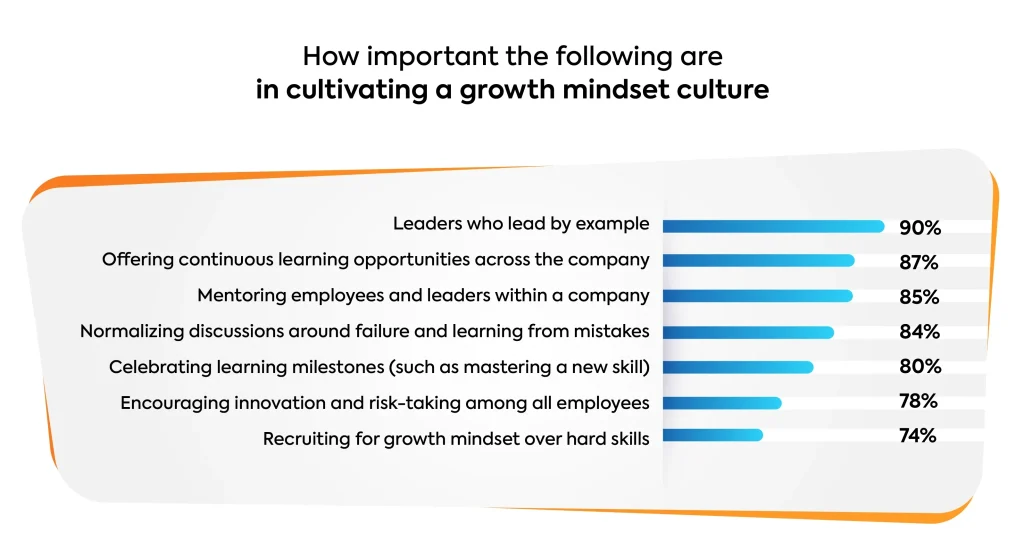
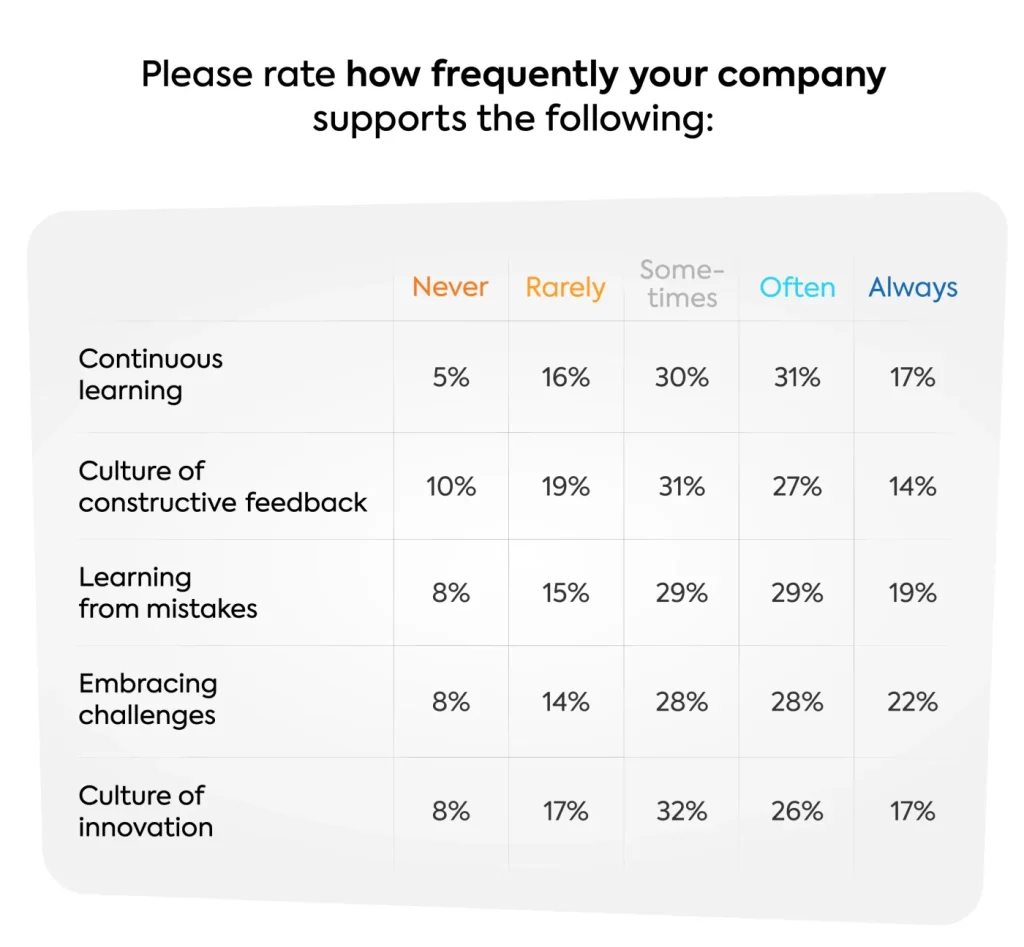
Nine in 10 leaders believe leading by example is key to creating a growth mindset culture. And 76% are actively working on cultivating a growth mindset within their organization. But what does this mean in practice? To gauge ongoing commitment from leadership teams, we asked employees to rate five key growth mindset traits according to the level of support provided. The findings paint a consistent and positive picture. Close to half of organizations actively support each of the five growth mindset traits frequently or always.
Execs and employees join hands in support of continuous learning
Continuous learning received the most overall support from respondents. Forty-nine percent of employees say their company supports continuous learning, frequently or always, while 30% agree it happens sometimes. Executive insights add weight to this finding. The stats show that 87% of senior leaders agree that offering continuous learning opportunities is a major cornerstone in creating a growth mindset culture. And 55% confirm that their companies have already implemented ongoing training and development programs to support continuous learning for employees.
Embracing challenges, welcoming feedback, learning from mistakes
Viewing obstacles as opportunities for growth ranks almost as highly. Fifty percent of employees say their company embraces challenges frequently or always. And 28% see evidence of this sometimes. Almost half (48%) of employees say their company always or frequently supports learning from mistakes. And 29% acknowledge it happens sometimes. Underlining this commitment, 84% of senior leaders agree that normalizing discussions about failure and learning from mistakes is vital when creating a growth mindset culture. That said, developmental feedback gets a less resounding pat on the back. Only 41% of employees say their company supports a culture of constructive feedback.
Means and motivation: The brio behind the buy-in
Sustaining a growth mindset culture requires ongoing commitment. We’ve seen ‘how’ companies are encouraging this through support for learning-oriented traits, skills, and strategies. However, continued engagement takes more than a series of strategies. It also requires motivation. So, what energizes leaders to promote and embody a growth mindset culture? And why should team members follow suit? To understand more, we zoned in on the benefits of a growth mindset culture.
A growth mindset is directly linked to organizational success, say executives
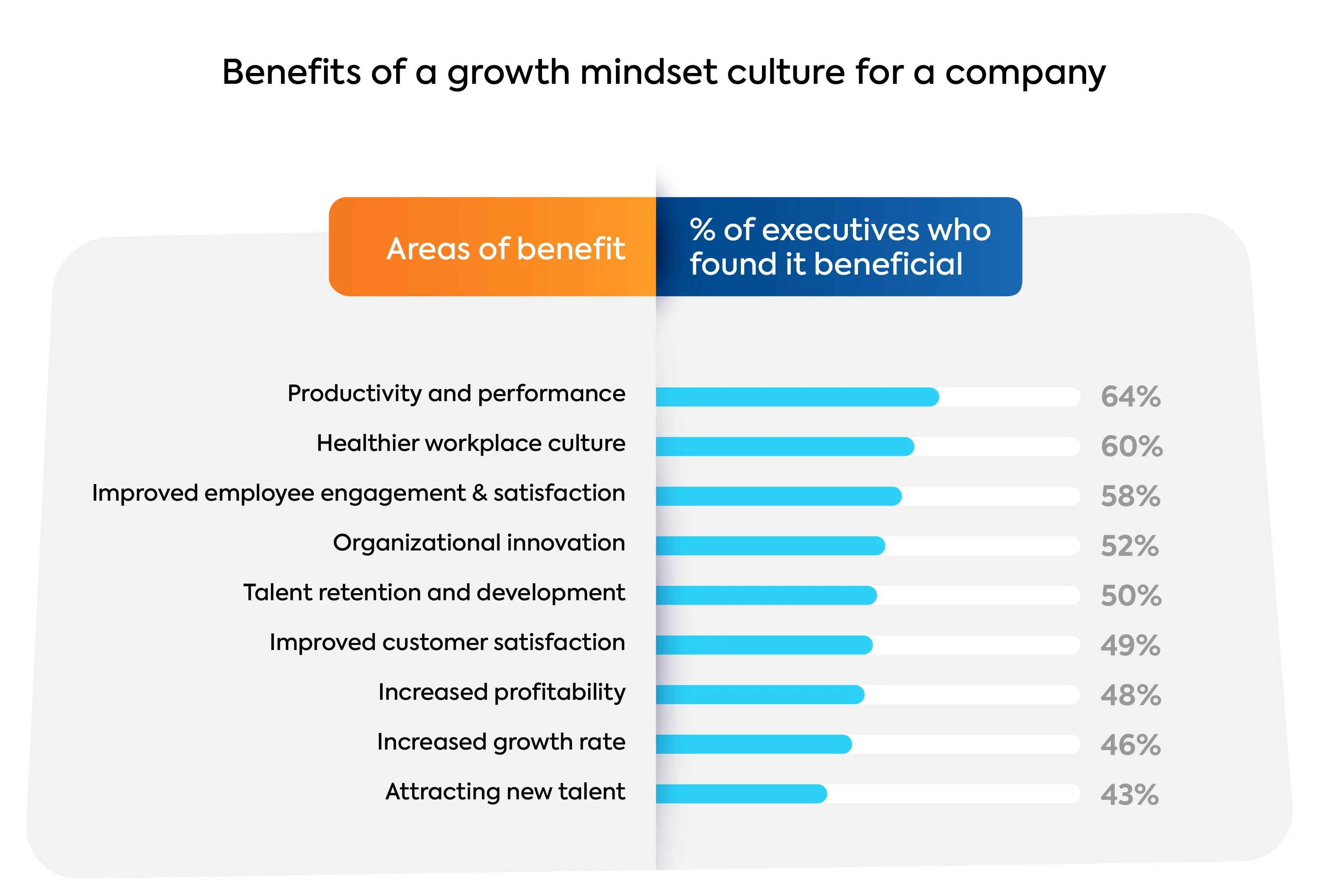
Senior leaders can see a clear trajectory from a growth mindset culture to better organizational outcomes. Over half of respondents point towards benefits such as employee engagement, innovation, and a healthier workplace culture. But most evidence supports a link between a growth mindset and tangible business benefits. For example, 88% of executives agree that a growth mindset is important for organizational success.
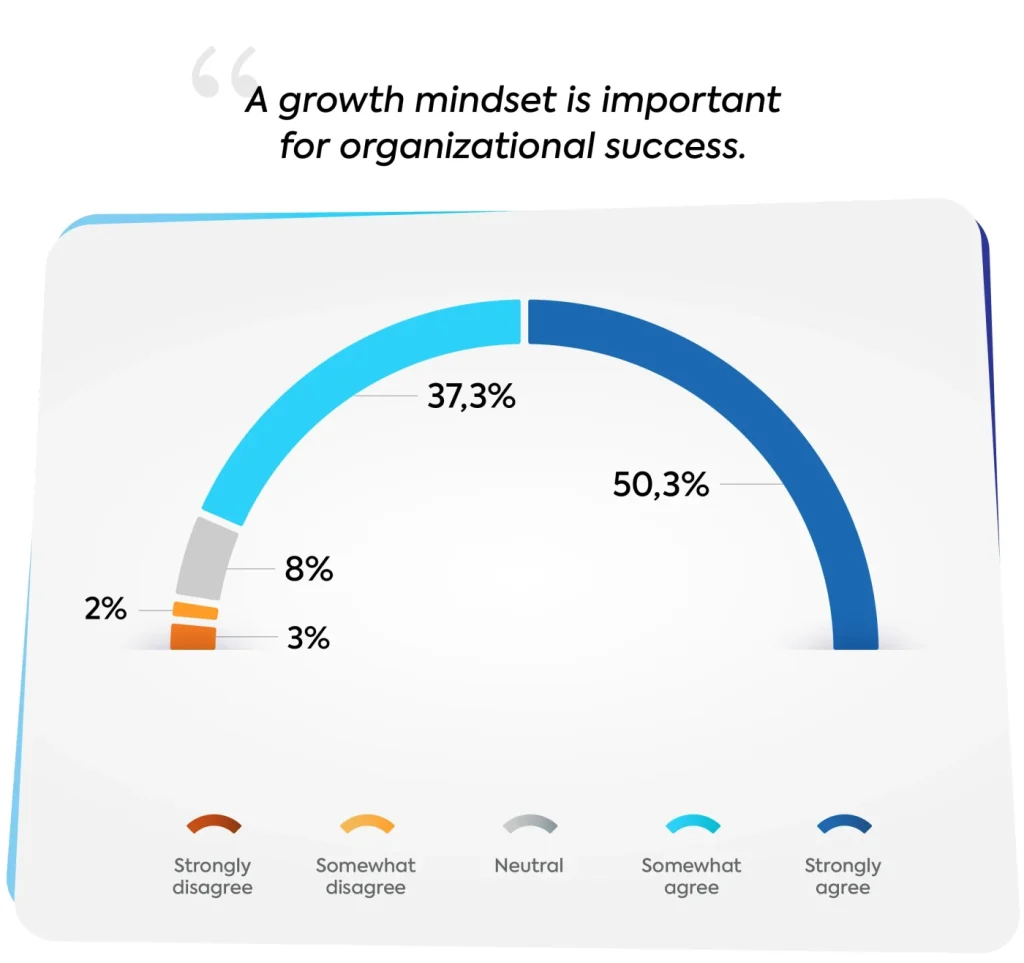
In addition, 80% say employees’ growth mindset directly contributes to revenue growth. Finally, nearly two-thirds (64%) view productivity and performance as key benefits of a growth mindset culture.
Reporting for (in)action
That said, less than half of executives link increased profitability and growth rates with a growth mindset. This poses an interesting question. Do senior leaders not see the value here, or has the value not yet been proven? Interestingly, 26% of executives also say that focusing on short-term results is a common challenge organizations face in developing a growth mindset culture. For L&D teams, this could be something worth digging deeper into internally. What do current levels of ROI reporting look like for growth mindset initiatives? Are they too narrow?
Over half of HR professionals (54%) agree that leadership often sees L&D as a cost and not an investment. So, rich reporting is key to sustaining ongoing investment from C-suite members and senior leaders (both mentally and financially). This means not just tracking short-term gains but longer-term benefits, too. If a complete metrics package isn’t available, it’s harder to build a clear picture of the benefits now and in the future.
Part of a bigger picture
Of course, it’s not all about the bottom line. Adopting a growth mindset has to offer some personal benefits, too. But what keeps employees committed? The top three motivators we pinpointed all tap into broader workplace trends: well-being, reward, and career progression.
Is a growth mindset the answer to well-being in the workplace?
According to Gallup’s 2024 State of the Global Workplace Report, 58% of employees struggle at work. And 41% cite stress as a regular cause of this. The mental health of younger workers is also a growing concern. Recent TalentLMS research also shows that a third of all working Gen Zers find it hard to cope with pressure and stress at work. Our study backs all of this up.
When we asked employees to vote for the skills they would most like to develop in the next 12 months, stress management came top. Against this backdrop, it’s clear why a positive and encouraging workplace culture is the top motivator for developing a growth mindset. The principles behind a growth mindset also reinforce this link. By breaking challenges into manageable chunks, encouraging resilience, and reinforcing a positive outlook, employees with a growth mindset can tap into a useful skill set to manage stress. And, by doing so, create a healthier working environment.
Monetary compensation is (still) a powerful motivator for self-improvement
Earlier this year, we examined how employees view appreciation practices in the workplace. And we found that 59% of employees value cash bonuses over all other forms of appreciation at work. Our growth mindset research adds weight to this finding. Financial incentives are the runner-up motivator for developing a growth mindset, following a positive and encouraging workplace culture closely. And 76% of executives agree that a growth mindset significantly impacts employees’ chances for pay raises and promotions.
A growth mindset is also good news for lower-income earners. According to a series of studies, the more HR managers believe in an adaptive mindset, the more likely they are to increase wages for workers in the poorest pay brackets. On a slightly sour note, 43% of employees see a growth mindset in the workplace as an excuse to assign employees more responsibility without adequate compensation. Generally speaking, a growth mindset is considered a force for good. So, this example of a growth mindset misapplied stands out as an early warning sign for HR teams. And a potential trigger for future action to set the record straight.
Growing minds grow careers
In a 2022 McKinsey & Company study, 41% of the employees surveyed quit their last job due to a lack of career advancement opportunities. Our research into a growth mindset confirms this as an equally emotive subject for employees. For 36% of non-exec employees, career advancement opportunities are rated as one of the top motivating factors for developing a growth mindset. And 79% agree that having a growth mindset is important to stay competitive in the job market. The link between a growth mindset and career advancement is also recognized by executives. Eighty-eight percent of senior leaders view a growth mindset as the key to professional and personal development.
The barriers to developing a growth mindset
According to our research, the driving factors for developing a growth mindset are both emotive and practical. They apply equally well to personal and business success. And they’re underpinned by wider industry insights, which make them even more compelling. So, what’s stopping the seamless adoption of a growth mindset in the workplace? To learn more, we examined potential roadblocks on both an organizational and individual level.
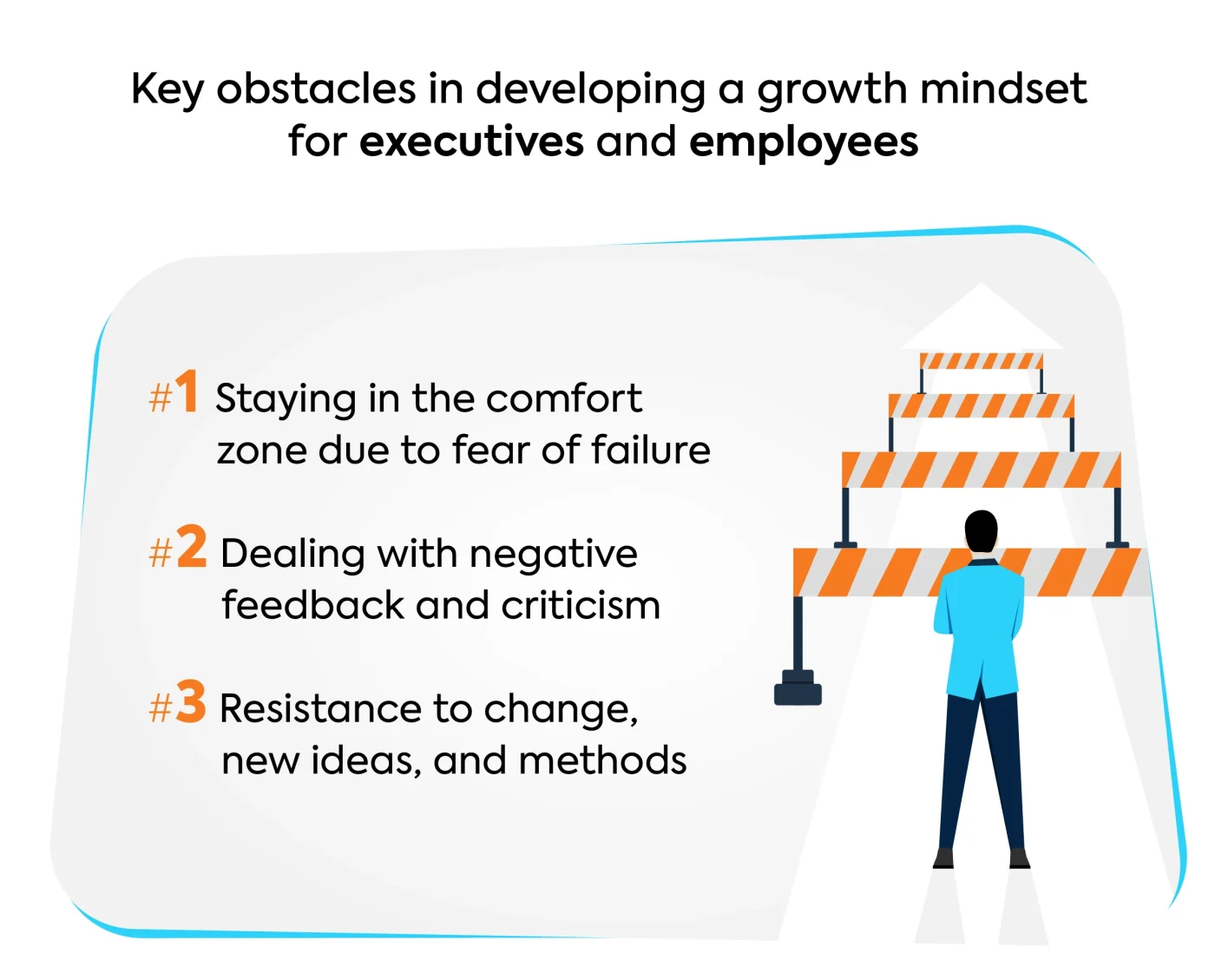
Resistance to change is the biggest barrier to a growth mindset culture
Senior leaders have a bird’s eye view of the workplace. This means they’re well-placed to track general trends, patterns of behavior, and cultural shifts. Tapping into this unique perspective, we asked executives about the barriers preventing a growth mindset culture. What have they witnessed first-hand that’s stunting adoption in their organization? Interestingly, none of the top three obstacles speak directly to a growth mindset culture. Instead, they stem from broader issues associated with workplace transformation. Resistance to change is a top-ranked challenge. It is followed by inconsistent leadership and a focus on short-term results.
Could do better: Behavior modeling at leadership level needs work
The high level of resistance identified by leaders is a strong hint for HR teams to look further into change management initiatives. But it’s also a loud call to action to explore strategies around behavior modeling among leadership teams. Nurturing a (new) company-wide culture isn’t a set-and-forget exercise. It takes ongoing commitment from those guiding the strategy. If senior leaders are inconsistent or passively ignore elements of a growth culture, widespread adoption won’t happen.
The (power) struggle is real: A fifth of senior leaders sabotage a growth culture to protect their position
Adopting a growth mindset culture also relies on a positive working environment built on trust, empathy, and mutual support. One potential threat to this comes if we look further down the list of obstacles. Over a fifth (21%) of all executives have witnessed leadership gatekeeping within their organization. Leadership gatekeeping refers to the practice of blocking the progression and development of others to maintain power. As such, it’s a direct challenge to the founding principle behind a growth mindset. It’s also a sign of a toxic workplace culture. And not the first hint of a link between leadership and an abuse of power. In our study of toxicity in the tech industry, 45% of employees agreed that senior executives promote unhealthy competition among managers and employees. The truth is, a growth mindset culture and toxic workplace culture don’t mix. Which makes this more than an early warning sign for HR teams. It’s a red flag for urgent action.
A great leveler: Executives and employees face the same pain points
Leaders have an added layer of responsibility when promoting a growth mindset culture. And they encounter different challenges because of this. But, the top three obstacles they face when developing their own adaptive learning mindset match those of other employees. Executives cite staying in their comfort zone due to fear of failure as a key barrier to developing their own growth mindset. The top-ranked barrier is the same for non-exec employees. Dealing with feedback and criticism is the second-biggest challenge for both groups. Third on the list* is resistance to change, new ideas, and methods. This last common challenge echoes the biggest barrier to a growth mindset culture. And suggests this could be a serious blind spot for organizations.(*Note: Discouragement in the face of setbacks also ranks joint third for employees).
Unlocking a growth mindset with learning and development
The workplace is busy and full of (often conflicting) demands. Without easy-to-access learning and development opportunities, a growth mindset has to fight for survival. From formal training programs to on-the-job work shadowing, L&D initiatives keep continuous learning alive and thriving. So, what’s the current state of learning and development in the workplace? Does reality meet expectations? Let’s see what executives and employees have to say.
Should I stay or should I go? Continuous learning squares up to career progression
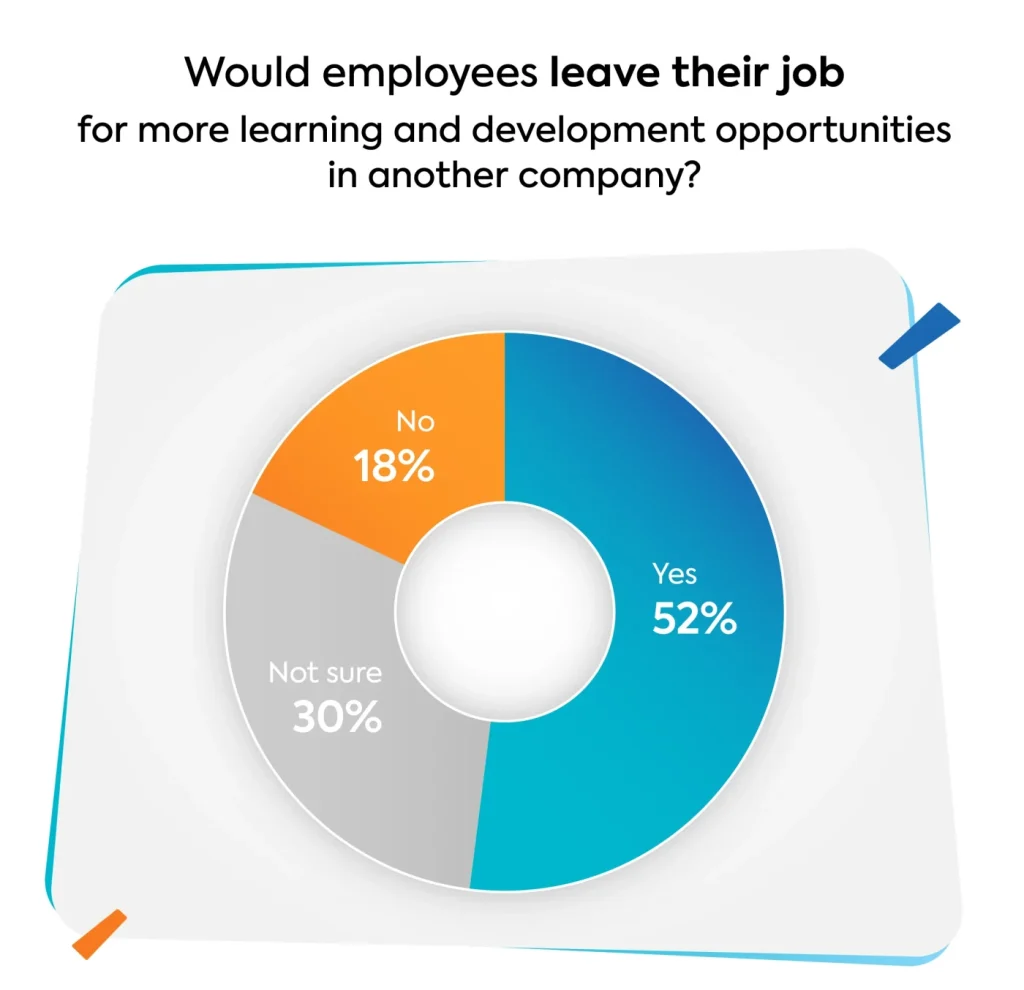
Recruitment eats up time, takes up headspace, and blows up budgets. Which is why retention is such a hot topic for businesses. Understanding what keeps employees loyal and on the payroll is the first step to reducing turnover—and it’s gold dust in the hands of HR teams. So, what do we know? We already know that lack of career progression is a big trigger for employee attrition. And the good news is that 65% of employees say their current company already offers opportunities for promotions and professional growth. On the flip side, 23% say their current company doesn’t offer opportunities for promotions and professional growth.
But we now also know that career progression isn’t the only driving factor. According to our research, over half (52%) of employees would leave their jobs for a company offering more continuous learning and development opportunities.
Two winning sides in the war for talent
Of course, most organizations can’t thrive on retention strategies alone. Hiring externally still has a key role to play. Based on our findings, a commitment to learning and development can address both sides of the talent acquisition scale. That’s why 89% of executives agree that investing in employee growth is good for attracting as well as retaining talent. Forty-three percent of executives add detail to this finding by pinpointing the importance of a growth mindset in attracting new talent. And a hefty 80% of employees also think those with a growth mindset will be more successful in the workplace of the future—wherever that may be.
Limited budgets don’t limit learning (yet)
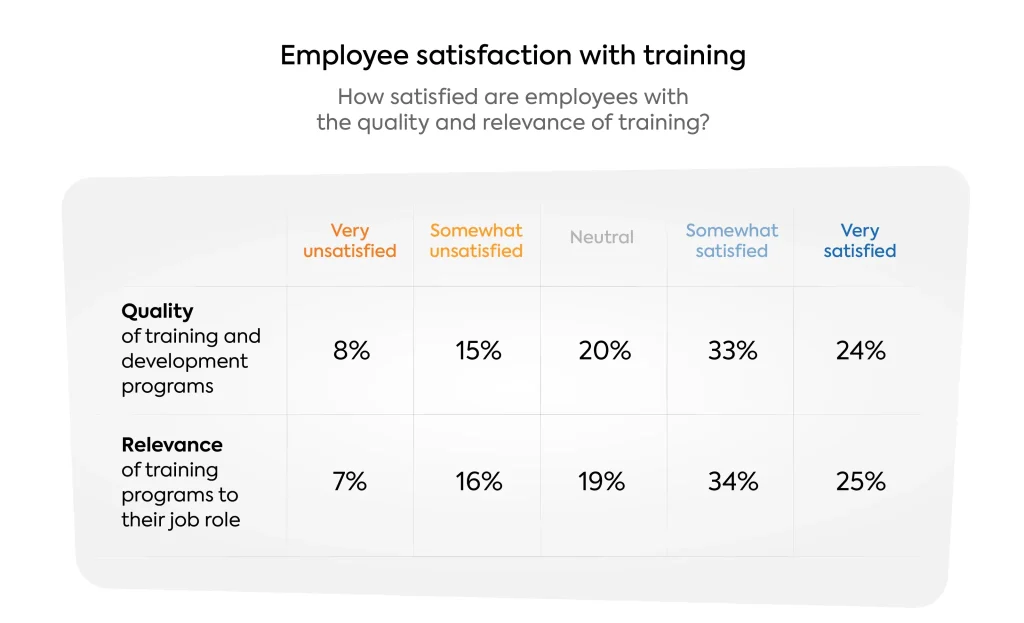
Providing universal learning development opportunities comes at a cost. Time, money, and resources are all heavily leaned on. Our study shows that two-thirds of employees expect companies to invest in their career and professional growth. Yet, 56% of executives agree it’s challenging to find the budget for this. Despite the struggle, provision appears to meet employee expectations. Our data shows that 57% of employees are satisfied with the quality of training and development programs their company offers. Nearly two-thirds (62%) agree that their company provides the necessary resources for skill development. And 58% are satisfied with the relevance of training programs to their job role.
On-the-job training gets the thumbs-up from employees
There’s potentially more good news for budget holders. We asked employees to rate their preferred learning methods. The runaway winner was on-the-job learning. This was followed, at a distance, by mentorship and coaching.
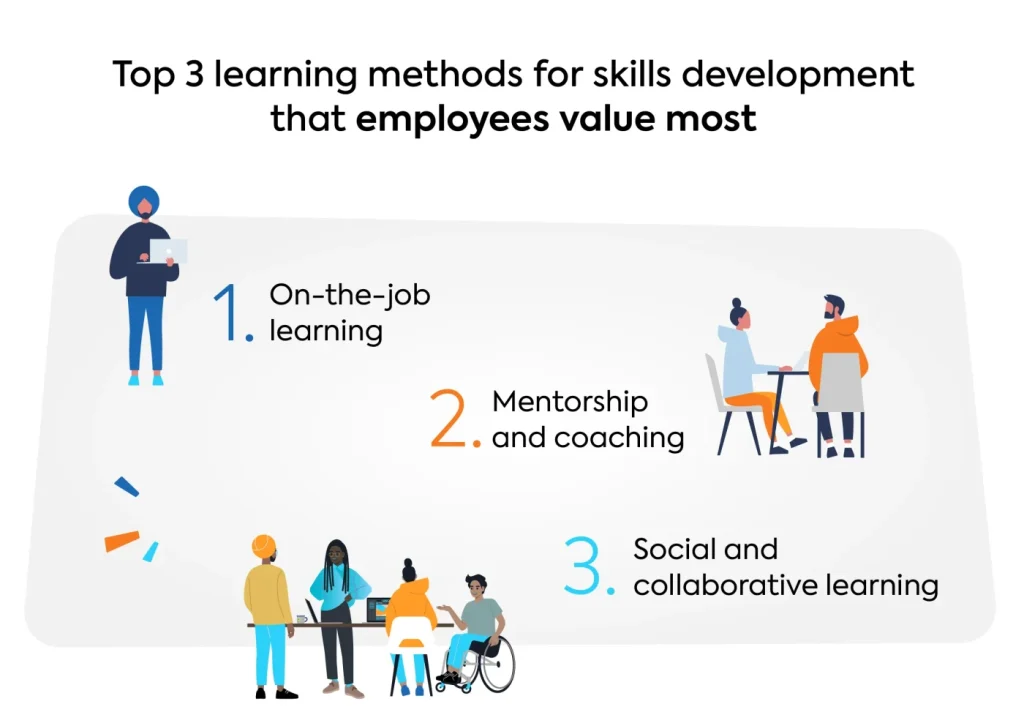
At the other end of the scale, the leading L&D initiatives currently being implemented by executives aren’t quite so budget-friendly. Ongoing training and development programs top the list. Followed by access to industry conferences, seminars, and workshops. At first view, there’s money to be saved here. On-the-job training puts far less pressure on the purse strings than access to industry conferences, seminars, and workshops. But there are other aspects to consider. Effectiveness, relevance, and practicality must also be factored in. Either way, it’s something for HR teams to look further into.
Leadership through the lens of a growth mindset
“Foundational research by the Center for Creative Leadership (CCL) found that leaders who excel over time separate themselves from others on one key attribute: they turn key events we all have into “lessons of experience” that alter the way they show up in the world. To do this well, a leader must build exceptional self-awareness, listening skills, and the ability to critically reflect on experiences they have.”
For 87% of executives, a growth mindset is a characteristic of great leaders. Yet, 42% of executives struggle to balance short-term business goals with long-term growth mindset initiatives. Our research opens up a potential conflict here. A growth mindset could hold the key to great leadership. But without a proper strategy in place, it may risk bringing substantial impact.
Is there time to dare to fail?
Many of the world’s most celebrated and successful individuals exemplify a growth mindset in their leadership styles. Particularly the courage to try and fail. Before perfecting the lightbulb, Thomas Edison made at least 1,000 non-working prototypes. And for Theodore Roosevelt, glory in leadership goes to the “man in the arena” daring to fail. Research from Deloitte brings this mantra up-to-date. Leaders in high-performing organizations are 28 times more likely to take risks and model learning from mistakes than leaders in low-performing organizations. So, how does our study stack up against this?
We’ve seen that confidence in the power of learning from mistakes is high among leaders. (For example, 95% of executives develop a growth mindset by learning from mistakes and failures.) But how often do they feel able to do this? Here’s the misstep in the path. Can a risk-taking mindset survive if, as we’ve seen, immediate business goals are competing for attention? The answer is yes. But, great leaders (to-be) need ongoing support and strategies to navigate this challenge
Better communication needed to complete the circle of trust
In workplaces across the US, trust in leadership is low. According to Gallup, only 23% of employees trust the leadership within their organization. This is a ticking time bomb for organizations. Could cultivating a growth mindset at a senior level provide an answer? When we refer back to the traits of a growth mindset, there’s a clear correlation. Continuous learning, embracing feedback, resilience, persistence, flexibility, and courage are all hallmarks of a growth mindset. And, equally, all capabilities that nurture trust and authenticity in leadership. This is a solid place to start.
But for trust to grow, leaders must maintain an open and ongoing dialogue with their teams. As it stands, 58% of employees are satisfied with the transparency of communication from leadership. But with 27% being dissatisfied, that leaves sufficient room for improvement.
Combining AI with a growth mindset in learning
AI is fast establishing itself as a positive force in workplaces. It’s redefining workflows, transforming data analysis, streamlining processes, and automating repetitive admin work. There is, though, a darker side. Well-being, for example. Early research suggests using AI at work may make employees more lonely and less healthy. So, what do we get when we bring emerging technologies and a growth mindset culture together? And what does this mean for leaders? Our study reveals that an equally mixed picture may pose challenges for executives.
AI-powered training: The good, the bad, and the not-so-sure
On the positive side, nearly two-thirds (65%) of executives already leverage technology to foster a growth mindset within their organization. And 59% of employees think AI-powered training tools can help them develop new skills. The opposite view? Half of them don’t have access to AI-powered training tools from their company.
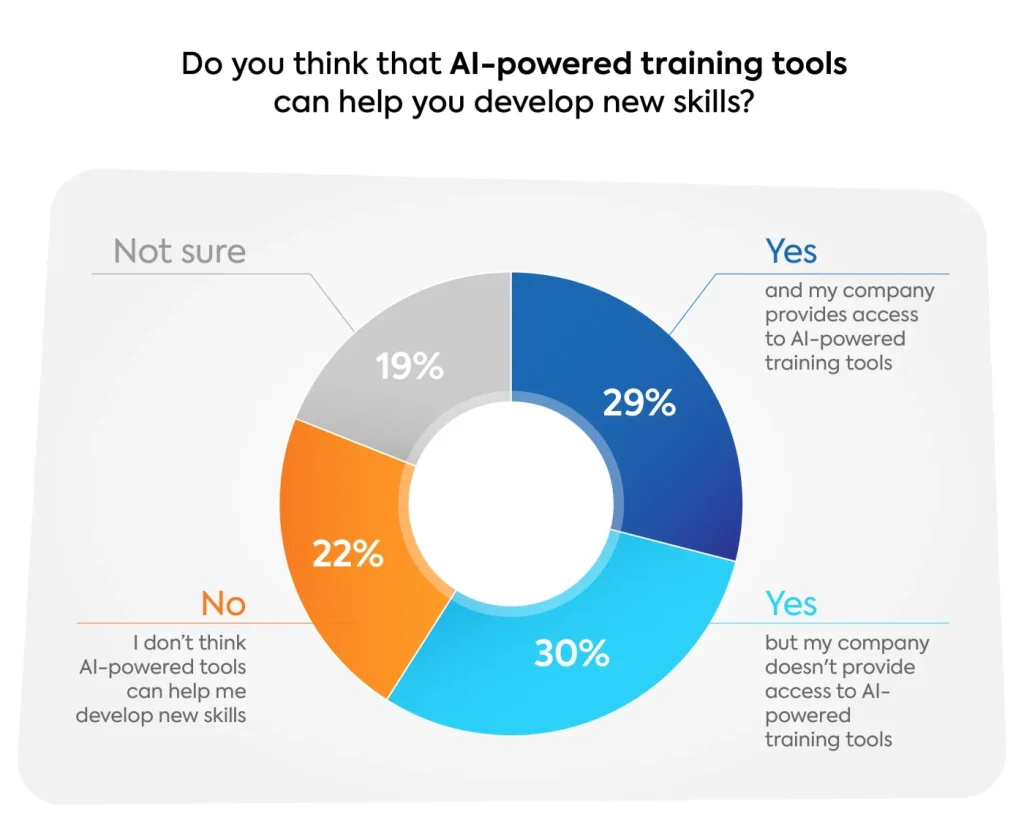
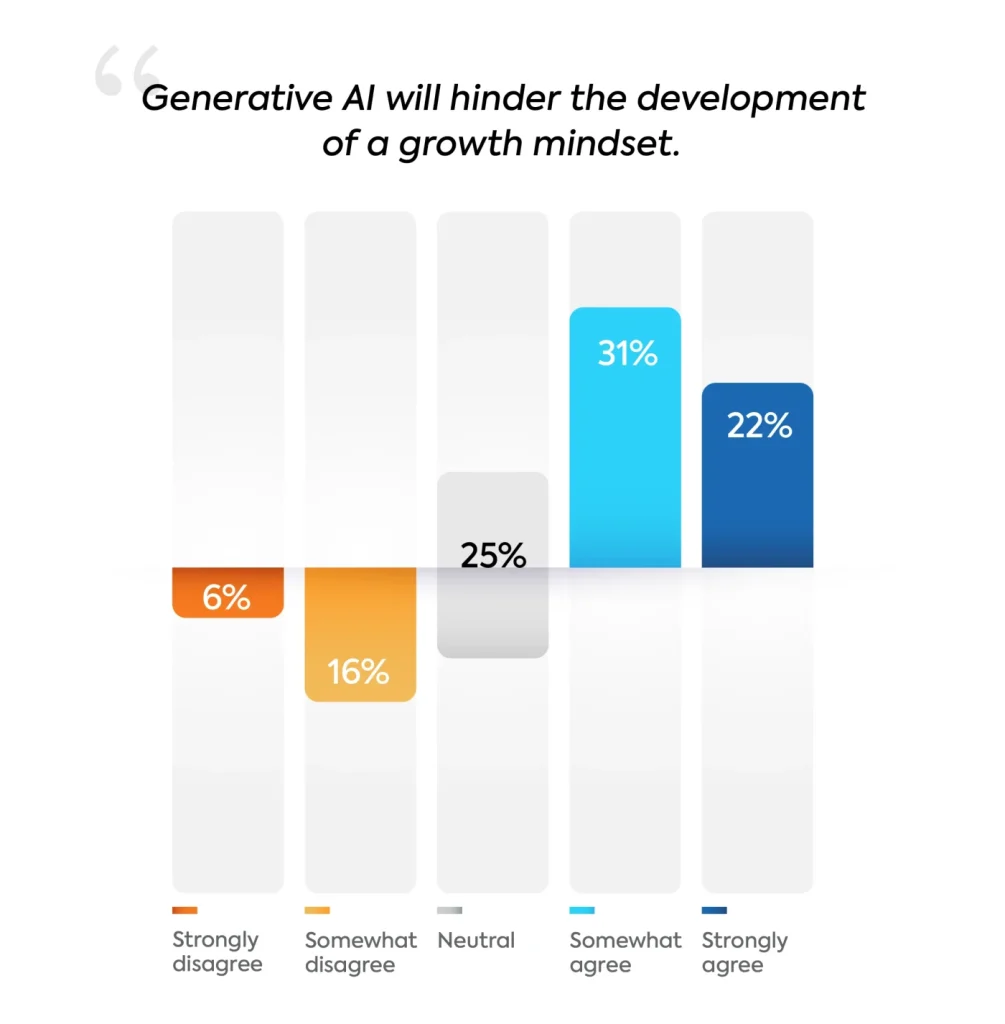
What’s more, over half (53%) of senior leaders agree that generative AI will hinder the development of a growth mindset. And just under half (43%) of employees agree. Previous research also underpins this skepticism. According to 40% of Gen Z employees, AI has hindered their growth by doing tasks from which they could have learned.
Applying AI to a growth mindset: 10 strategies for success
#1 Explore and explain AI’s potential for continuous learning
The reality, though, is that AI is here to stay. So, giving leaders the skills and support to navigate this uncertain landscape is a priority. Guided by the following strategies, businesses can integrate new technologies to foster a growth mindset while being mindful of the risks.
Use AI to create personalized/adaptive learning paths for employees based on skill sets, learning preferences, and career goals. Set up AI prompts for employees that suggest learning activities, articles, or courses.
#2 Help employees leverage new technologies with confidence.
Provide the right toolkit and resources. Offer training that develops the skills needed to work effectively with AI.
#3 Show how AI tools can be used to develop growth mindset traits.
Use AI to deliver real-time, data-driven feedback that helps learners view mistakes as opportunities for growth. Create AI-generated simulations and scenarios employees can use to practice risk-taking in a safe environment.
#4 Position AI as a tool that enhances, not replaces, human capabilities.
Encourage employees to use AI to complement their decision-making. Challenge teams to collaborate with AI tools to solve problems or create new concepts.
#5 Keep telling the full story.
Talk about AI’s role in nurturing a growth mindset in the workplace. Communicate how it works, its benefits, and its limitations. Address any concerns and clarify that AI is there to support, not undermine, employees’ roles.
#6 Model AI use at a leadership level.
Set a precedent. Encourage executives to adopt a “show, not tell” approach to AI tools and learning. This will foster a culture of transparency and trust around new technologies.
#7 Gather (and act on) feedback.
Provide opportunities for employees to discuss their experiences using AI for continuous learning. Share success stories. And be receptive to suggestions for improvement.
#8 Align AI use with organizational goals.
Help employees set and achieve specific, measurable personal growth goals using AI. This reinforces the idea that growth and improvement are ongoing processes supported by technology.
#9 Use AI tools to support a learning culture.
Create AI-enhanced, online learning communities where individuals can share their learning experiences, seek advice, and offer support.
#10 Show that effort leads to improvement.
Use AI to track learner progress and celebrate small wins and key milestones.
The missing pieces: A plan for the future
Time to take stock. What we’ve seen so far is a complex and (at times) contradictory picture of a growth mindset in the workplace. But there is also unequivocal simplicity and certainty. A growth mindset has high visibility in today’s workplace. Nearly all leaders believe they currently have a growth mindset, and most employees feel the same way. It also carries weight as 88% of executives already link a growth mindset with organizational success. The same number also associates it with great leadership.
But the story doesn’t end there. A growth mindset has carved out a permanent space for itself in the workplace of tomorrow. Eighty-five percent of leaders agree that a growth mindset will be crucial for market competitiveness in the coming decade. And 80% of employees think that having a growth mindset will make them more successful in the workplace of the future. But how can businesses harness this energy and optimize effectiveness over the next 12 months and beyond?
Here are some key pointers.
Addressing the skills gap
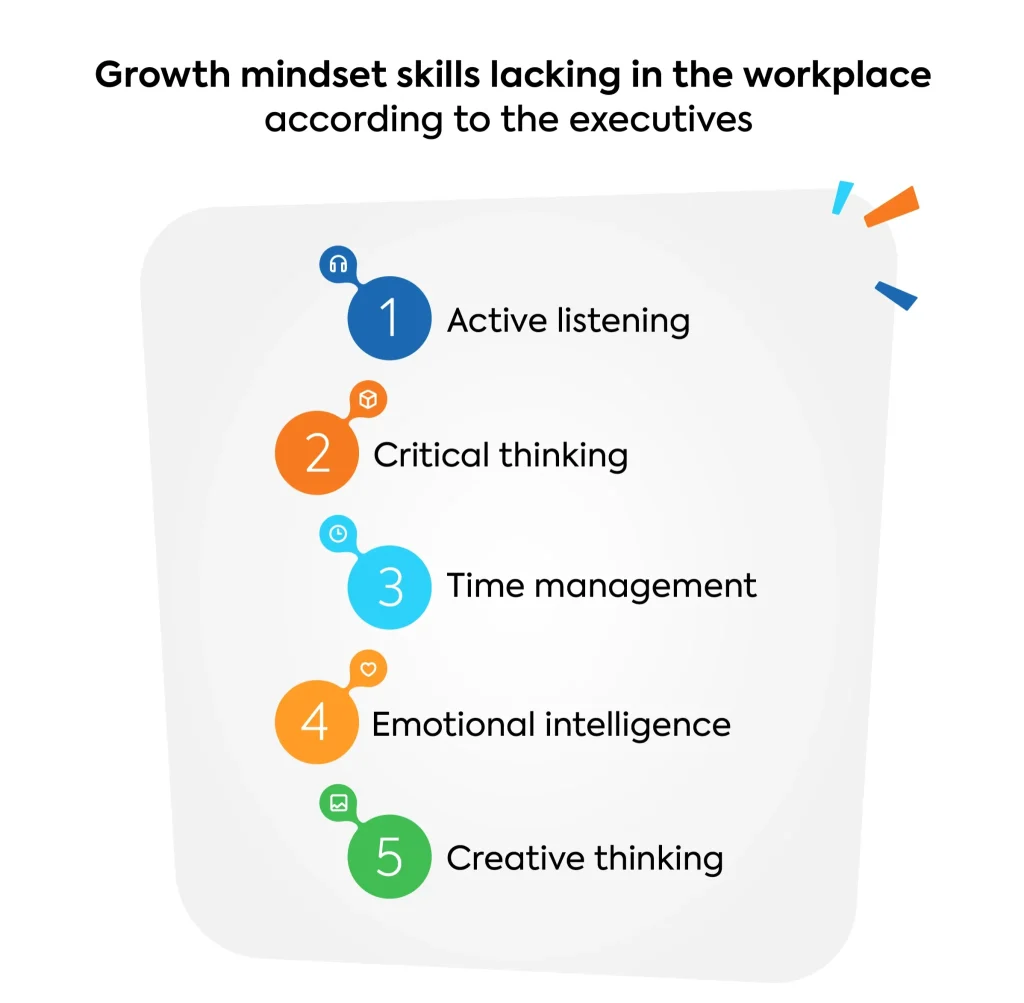
The skills associated with a growth mindset are wide and varied. So, where should L&D teams focus their attention? We asked the executives which skills they plan to prioritize over the next 12 months. The top-ranked skills were active listening, followed by creative thinking and ability to learn.
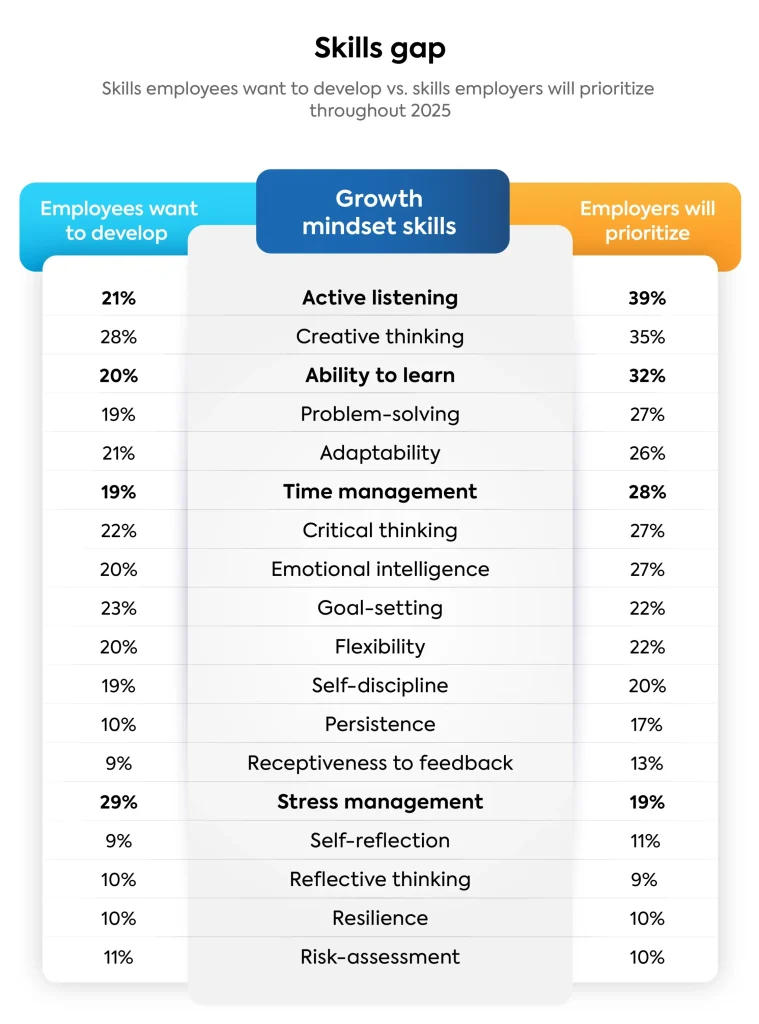
But how do these align with employees’ needs? To find out, we asked them which skills they’d like to develop in the next year. And the gap emerged. Employees ranked stress management first, followed by creative thinking and goal-setting. Only one skill out of three shows alignment.
To close the gap over the next year and beyond, businesses need to get clarity on internal skills requirements through skills surveys and skills gap assessments.
Working well with emerging technologies
The other three key skills executives plan to prioritize for development over the next year are the ability to learn, problem-solving, and adaptability. And they all have one notable thing in common. They’re all skills HR managers predict will be essential in the AI era. A coincidence? Possibly. But this crossover between AI aptitude and growth mindset capabilities is a sign of things to come.
To achieve success through a growth mindset, businesses must keep up with digital developments. They need to use new tools and technologies to make growth mindset practices, principles, and processes more accessible and effective. And give employees the skills they need to work well in this environment.
Looking to your leaders
The final link in the growth mindset chain is arguably the most important. It stems from one of the most powerful takeaways of this research—89% of executives believe that future business success will depend on leaders who embody a growth mindset.
Senior leaders play a grounding role in defining company culture. Their decisions, behaviors, and attitudes set the tone for other employees. All of these factors combine to shape the organizational landscape. Fuelled by a growth mindset, that landscape becomes one of innovation, risk-taking, continuous learning, persistence, and ongoing improvement. This powerful combination of factors leads to better business outcomes. Productivity, performance, and increased profits boost the bottom line. Retention, engagement, and well-being lead to better long-term stability. Given all of this, it’s no surprise that leadership teams in high-performing organizations are more likely to model a growth mindset.
Conclusion: With a growth mindset (almost) anything is possible
Our study shows that the starting blocks for a leader-driven growth mindset culture are already in place. Over three-quarters (76%) of all executives are actively working on cultivating a growth mindset culture. But what building blocks are required to optimize this energy moving forward? Ongoing training, support, feedback, and resources are all essential if existing leaders are to keep mindset strategies alive. Just as important, though, are strategies to support future leaders. Leadership potential thrives in growth-mindset companies. The belief that talent can and should be developed in everyone, combined with a commitment to ongoing learning, enriches the leadership pool. Which, in turn, makes anything possible. And for businesses, you can’t ask for much better than that.
Five bonus tips for boosting a growth mindset
- Hire employees who demonstrate ambition, regardless of role or level of responsibility. Evaluate growth mindset traits during the hiring process.
- Make it possible for employees to spend time in different roles and departments, exploring different skill sets.
- Offer a dedicated allowance employees can use externally to further their education.
- Allow employees to find their own processes for completing their tasks and responsibilities.
- Create a channel or forum for employees to submit new ideas or challenge existing ones. Give equal consideration to all contributions.
About the research
The survey was conducted online between August 7 and August 14, 2024, with two sample groups. Minor discrepancies in total figures may exist due to rounding.
Group 1: 1,000 employees in the U.S. across different industries.
Gender breakdown: Female (52.7%) | Male (47.3%)
Group 2: 300 executives in the U.S. across different industries, occupying the following roles: President/CEO/Chairperson, C-level executive, Chief Financial Officer CFO, Chief Technical Officer (CTO), Senior Management, Director, Owner or partner
Gender breakdown: Female (41.3%) | Male (58.7%)
Research team
Ana Casic (TalentLMS), Fiona McSweeney (TalentLMS), Marialena Kanaki, Giota Gavala (TalentLMS)
Download the report
Dive deeper into original research by TalentLMS




Build a strong learning culture in your organization with TalentLMS
Sign up in seconds, test the platform, and upgrade whenever.